Short daily sessions
Five questions, 3-5 minutes, done. Bite-sized sessions make free TOEIC practice online a daily habit you can actually keep, instead of one long test you keep putting off.

Friendly TOEIC-style Reading Practice
Five categories. Five questions per session. Every answer comes with a clear explanation in English and Thai. Built for Thai learners and English learners worldwide who want a free TOEIC test online — practise a few minutes a day and aim for a 400+ Reading score (out of 495).
Not affiliated with ETS or the official TOEIC test. Practice material only.
Our question bank
readwise is built on one of the largest free TOEIC practice banks online: more than 20,000 original, TOEIC-style Reading questions written in modern business-English contexts and audited for accuracy. They are written in the style of the real exam, not copied from any ETS or TOEIC test, and they span all five Reading categories so every free TOEIC practice session feels fresh. Whether you want a quick TOEIC vocabulary test, a TOEIC grammar test, or longer business English reading practice, every question comes with an answer and a clear explanation.
20,000+
Questions
5
Categories
3-5 min
Per session
100%
Free
Free sample questions · no signup
Take a free 5-question TOEIC level test right on this page. No signup, no credit card, no login. Each question is answered instantly with a clear explanation, so you can see our TOEIC-style Reading questions before you create an account. The sample rotates, so there is always something new to try.
Why readwise
Five questions, 3-5 minutes, done. Bite-sized sessions make free TOEIC practice online a daily habit you can actually keep, instead of one long test you keep putting off.
Every TOEIC-style question comes with answers and a plain explanation in English and Thai, so you learn the grammar point or vocabulary word behind each answer, not just whether you were right.
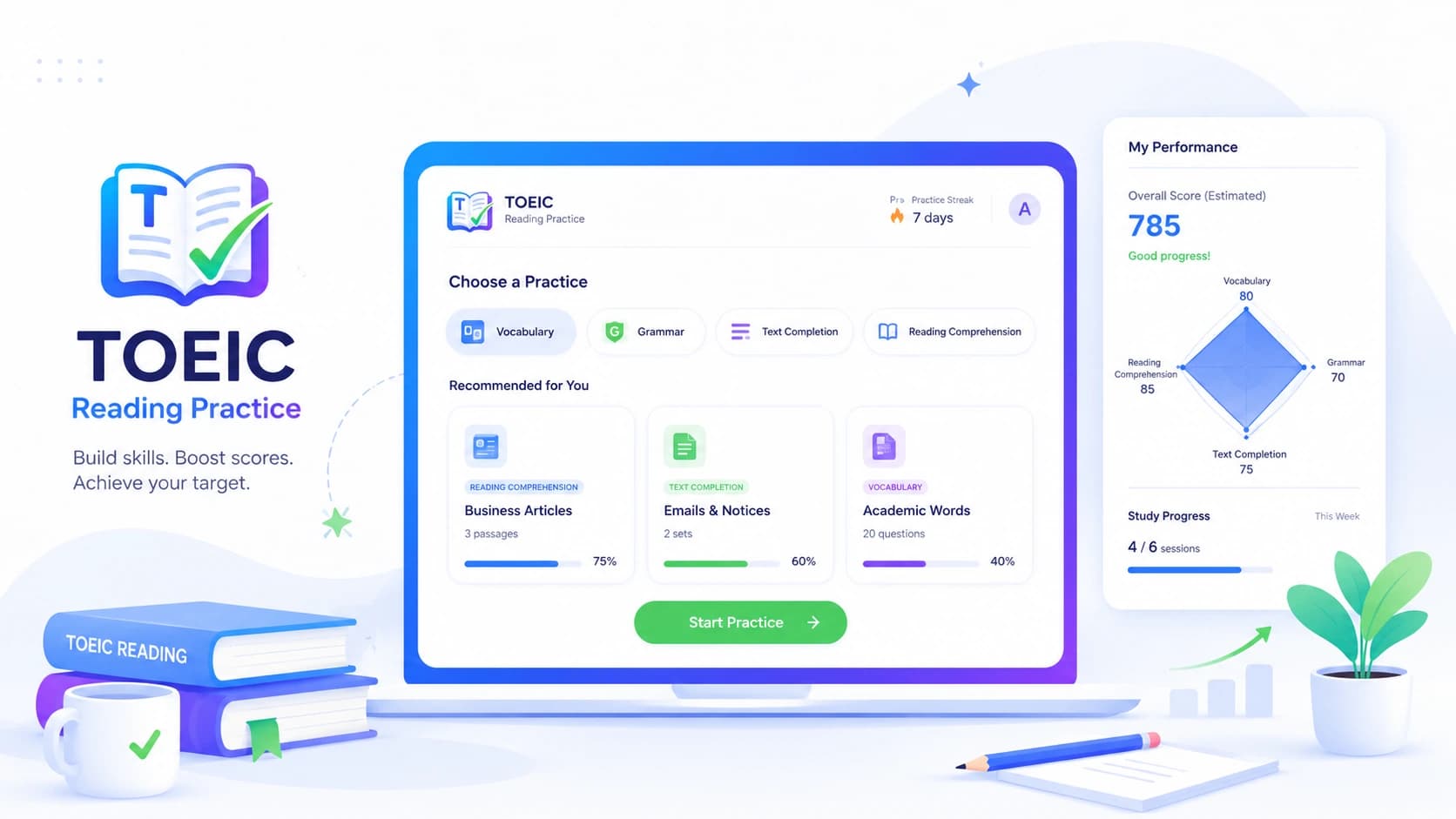
Your dashboard maps your strengths and weak spots on a per-category radar chart and recommends what to practise next, so each TOEIC practice test session moves your business English reading practice in the right direction.
Reading categories
Build the high-frequency TOEIC vocabulary words you meet in everyday business English, with each answer shown in context so the meaning sticks.
A focused TOEIC grammar test covering word forms, tenses, prepositions, conjunctions, and subject-verb agreement, with an explanation after every question.
Part 5-style TOEIC incomplete sentences with answers: pick the word that best completes each sentence and review the grammar point behind it. A clean way to practise TOEIC Part 5 with answers and explanations.
Part 6-style passages with multiple blanks that test how well you keep grammar, vocabulary, and meaning consistent across a short business text.
Part 7-style emails, notices, articles, and reports where you read for detail and inference, the way you would in real workplace English.
A practice mode that samples across all five categories at once, like a quick TOEIC mock test to check where you stand overall.
How it works
Create a free account with just your email, name, and date of birth. No password, no credit card, and no Google or Facebook login required. Or try the free sample first with no signup.
Pick one of the five Reading categories, from a TOEIC vocabulary test to Part 5 incomplete sentences, or choose Mixed Random for a quick TOEIC mock test across all of them.
Finish your 5 questions to get your practice score, a per-question breakdown with explanations, and a dashboard that shows your strengths and the best category to practise next.
FAQ
TOEIC guides
If the sentence names a time period that is over — yesterday, last week, in 2019 — use the past simple. If the period still includes the present moment, or no time is named at all, use the present perfect. Almost every hard case is really a question about whether the time period has closed, not about what the verb means.
Read article →Every future form places the event at the same point in time. What separates them is why you believe it will happen: a decision made as you speak takes will, an intention formed earlier takes be going to, a fixed arrangement takes the present continuous, and a published schedule takes the present simple. Choose by evidence, not by date.
Read article →The past forms are not four ways of saying “earlier”. They set events in order relative to one another: the past continuous supplies the background, the past simple supplies the event, the past perfect reaches back behind the point the story has already reached, and the past perfect continuous measures how long something ran before that point.
Read article →Four sets of six, built so that each item turns on a single visible signal — a time expression, a conjunction, or a stative verb. Work through a set, check the reasons rather than just the answers, and use the diagnostic table to pick what to read next.
Read article →Create a free account with your email and date of birth to save your scores, track your progress, and see your per-category strengths. No password to remember, no credit card, no subscription. Or try the free 5-question sample first, with no signup at all.